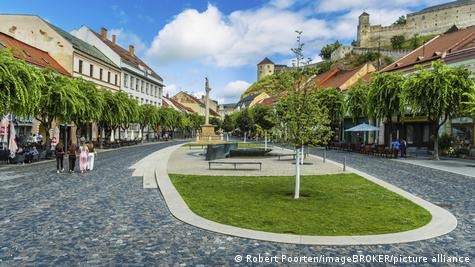
Trencin is a picturesque city in western Slovakia, best known for its historic castle perched on a rock above the city. Below it, the city center is nestled around a large square lined with cafes and bars.
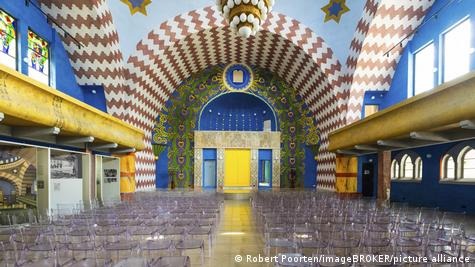
The old town is also home to a magnificent synagogue that was recently renovated and stands as a powerful symbol of Trencin’s centuries-old Jewish community. Today, it occupies a central place in the city as both a tourist attraction and a venue for cultural events.
Trencin is home to around 55,000 people. Like much of Slovakia, the city near the border with the Czech Republic has been affected by depopulation, driven largely by political disillusionment. Many residents are dissatisfied with the left-wing populist government led by Prime Minister Robert Fico, whose cooperation with nationalist forces and confrontational stance toward the European Union and NATO, as well as his pro-Russia policies, have sparked widespread concern.
In response, Slovaks across the country have repeatedly taken to the streets, with regular protests signaling growing opposition to the current regime.
Festival for the entire city
Trencin is consciously trying to break away from this conservative image. In counterpoint to the national politics, the city presents itself as open and international something akin to the US city of Austin, which has developed its own progressive profile in politically conservative Texas.
Several projects in the program reflect this approach. Trencin’s Light Art Festival uses light installations to retell the city’s story and create a sense of new beginnings.
The Lively Neighbourhoods project connects entire neighborhoods with festivals and workshops, a practical attempt to overcome social division.
The city’s European Capital of Culture motto is “Awakening Curiosity.” Events on the agenda include cabaret performances, neighborhood festivals and activities that promote social cohesion. The city hopes to become more attractive, especially for young people.
Trencin’s cultural center has recently undergone a renovation to the tune of €8 million ($9.4 million). It is equipped with dance and theater spaces, studios, workshops and a professional film studio. The goal is to attract people from the arts and culture sector and encourage them to stay.
Finland is also home to the telecommunications giant Nokia, which makes the northern Scandinavian country a global technology hub. The country also has a diverse arts scene.
In 2026, Oulu aims to showcase all of these features. The northern Finnish city, with a population of around 220,000, is located approximately 600 kilometers (375 miles) from the capital, Helsinki.
Nokia has established a campus in Oulu that focuses on 5G and 6G technologies, while highlighting research and education.
Oulu’s art scene, meanwhile, is distinguished by its close connection to nature.