When Chandlee Begay sits down to eat the foods of his tribe, he isn’t simply satisfying hunger. Each bite becomes a quiet act of remembrance, a thread connecting him to generations who walked the same mesas, gathered the same herbs and shared stories over similar meals. The flavors carry echoes of his ancestors — their resilience, their celebrations, their prayers. In that moment, the meal is more than sustenance; it is ceremony, gratitude and a living homage to the people whose footsteps still guide him forward.
Begay, a third-year student at Arizona State University majoring in both coastal and marine sciences and sustainability in the Rob Walton College of Global Futures, is planting that philosophy into the soil at all four ASU campuses.
Over the past two semesters, the Navajo student has led Indigenous agricultural demonstrations, blending cultural teachings with sustainable growing techniques.
His most recent event, a March 4 “Three Sisters” planting demonstration featuring corn, beans and squash, drew students and staff to the Garden Commons on ASU’s Polytechnic campus to listen, learn and, in some cases, reconsider their relationship with food.“For us, seeds are like our relatives,” Begay said. “We cultivate them, and they nourish us back. It’s a mutual relationship, and that connection is part of who we are.”
Chandlee Begay holds the “three sisters” seeds — beans, squash and corn — that he planted during a demonstration at ASU’s Polytechnic campus on March 4.
Garden Commons Program Manager Melissa Kruse-Peeples sees Begay’s work as both educational and deeply personal. The garden, built in phases beginning in 2019, was designed to create hands-on learning opportunities and connect students with the origins of their food.
“We always try to represent our student population and their cultures,” Kruse-Peeples said. “Having Chandlee lead not just with crops, but with the methods and cultural significance behind them gives people a deeper understanding of why these foods matter.”
Nestled near student housing and the dining hall, the Garden Commons has become more than a patch of green on a desert campus. Students gather there to study, socialize and volunteer, while others discover for the first time how carrots grow or how compost nourishes the soil.
Begay’s demonstrations fit naturally into that mission, offering a window into agricultural practices shaped by centuries of observation and respect for the land.
On the day of the Three Sisters planting, Begay stood before a small crowd with a handful of seeds: Navajo copper corn, tepary beans and squash. Each carried a story. The crops, he explained, are companion plants that support one another. Corn provides structure for the beans to climb, beans replenish nitrogen in the soil and squash vines shade the earth, conserving moisture.
But the lesson went beyond science. For many attendees, it was the first time they heard planting framed as both ecological knowledge and cultural tradition.
“I really appreciate the spiritual aspect of it, the tie between the land and people,” said Natalie Wolff, a third-year student worker at the garden. “It makes me more mindful about what I’m doing when I plant and produce food for others.”
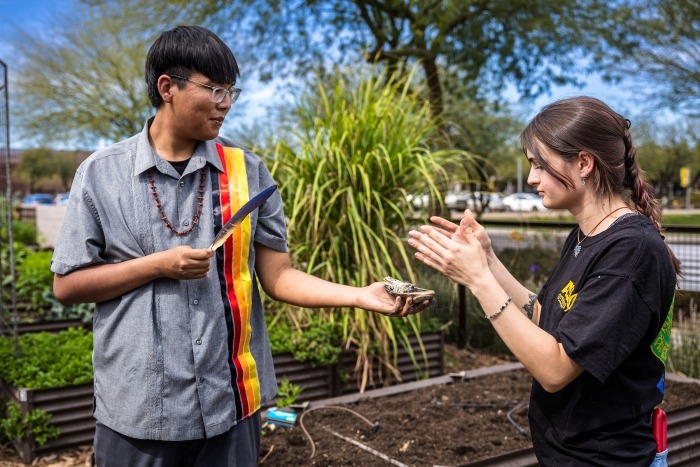
Chandlee Begay (left), offers cleansing sage smoke to Natalie Wolff during the Indigenous planting demonstration at the Polytechnic campus Garden Commons on March 4.
Others saw the demonstration as a bridge between cultures. Sumaya Said, another student worker, noted how Indigenous practices blend empirical understanding with cultural ritual.“They knew these plants were companion plants long before modern science explained it,” she said. “It’s beautiful how they mix science with culture.”
For Ahnaf Hoque, a first-year engineering student who grew up in Bangladesh, the experience offered perspective on the land he now calls home.“People who are native to the land will know what’s best for it,” he said. “As someone new, you should respect the traditions and understand the wisdom behind them.”
That sense of respect is precisely what Begay hopes to cultivate. His demonstrations are not just lessons in planting techniques, but invitations to see food as a relationship rather than a commodity. He talks about seed preservation, climate resilience and the loss of biodiversity, but also about kinship, reciprocity and responsibility to the Earth.
Samantha Fisher, a senior coordinator in student success and retention with ASU’s American Indian Student Support Services, called the initiative empowering for Indigenous students.“It strengthens that connection to nature and reminds us that our traditional foods and resources are still important,” said Fisher, whose tribal affiliations are Navajo and Hopi.
Even students from other Native backgrounds found common ground in Begay’s teachings. Elena Dominguez, a Yaqui student studying environmental management, said many tribes share similar beliefs about food and culture.“Seeds hold memory,” she said. “Our traditional foods nourish us in ways modern diets often don’t.”
The demonstrations are also personal, Begay said. He learned fragments of these practices growing up, but it wasn’t until college that he began to reconnect with them, studying seed conservation and Indigenous agriculture as part of his coursework. Now, he sees himself as both student and steward.
Melissa Nelson, professor of Indigenous sustainability in the School of Sustainability, part of the College of Global Futures, said mentoring Begay has been especially meaningful.
“It has been such a joy mentoring Chandlee in Native food systems and the revitalization of his traditional ecological knowledge of seeds and farming,” Nelson said. “Seeing his rapid growth from a quiet, perceptive student to now, an important teacher and emerging leader rooted in his Navajo heritage, is deeply rewarding and inspiring. It’s why I love teaching at ASU.”
As the afternoon sun settled over the garden beds, Begay pressed seeds into the soil, some tentatively and others with newfound purpose. In a few weeks, green shoots will emerge — small, quiet signs of growth. For Begay, they represent more than future harvests. They are living links between past and present, reminders that tradition can still take root in unexpected places.“Without food, we don’t have culture,” Begay said. “These seeds, our language, our songs, they’re all connected. Keeping these traditions alive helps to keep our people going.”