A look back at the year that was and wasn’t in politics.
As a purple state in an increasingly divided nation, Pennsylvania spends plenty of time in the national spotlight – and this year has been no exception.
The commonwealth’s three retention elections for seats on the state Supreme Court were watched closely as a bellwether for how voters would react to the first year of President Donald Trump’s second term in office. The state’s four-and-a-half-month budget impasse overlapped with the nation’s longest-ever federal government shutdown, leaving many Pennsylvanians concerned about how political gridlock would impact their day-to-day lives. And in a year when the U.S. was marred by political violence, the commonwealth narrowly avoided tragedy when an arsonist lit the Governor’s Residence on fire in a failed attempt to kill Gov. Josh Shapiro and his family.
As 2025 comes to a close, City & State recaps the year in Pennsylvania politics, examining what transpired and which agenda items remain outstanding heading into 2026
In a year that produced an endless amount of headlines, lawmakers at both the state and federal levels struggled to produce on-time budgets – and Pennsylvanians felt the consequences.
At the state level, Pennsylvania blew through the state’s June 30 budget deadline, resulting in a 135-day budget impasse that had school districts, county governments, rape crisis centers and other entities sounding the alarm as state payments went delayed. In Washington, D.C., a federal government shutdown – the longest in the nation’s history – disrupted food assistance programs and air travel.
The federal shutdown ultimately lasted for 43 days, while the state budget impasse stretched past four months.
Lawmakers and Gov. Josh Shapiro ultimately reached agreement on a $50.1 billion budget package that sent more money to public school districts, created a new tax credit for working-class Pennsylvanians and reformed how cyber charter schools in the state are funded. As part of the negotiated budget, Shapiro agreed to withdraw the commonwealth from the Regional Greenhouse Gas Initiative – a regional pact aimed at limiting carbon emissions from the power sector that drew criticism from Republican lawmakers and labor unions
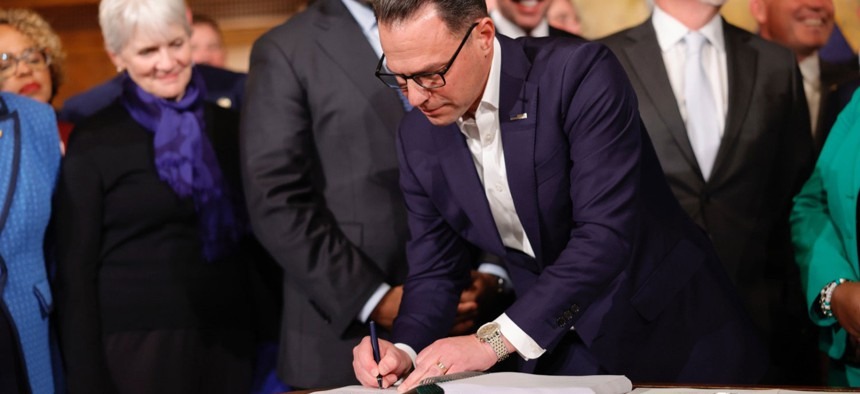
Shapiro framed the agreement as a bipartisan win for all parties involved. “I said at the outset of this process … to pass a budget, everyone was going to have to give a little and understand the perspectives of others a little bit better,” he said during the November press conference where he signed the budget into law. “We did that here and, as a result of our collective work, the good people of Pennsylvania are better off.”
“This is a balanced budget that cuts taxes, that makes critical investments, that protects 100% of Pennsylvania’s Rainy Day Fund and still leaves us with $8 billion in reserves.”
State Senate President Pro Tempore Kim Ward echoed Shapiro’s sentiments on having to compromise given the political dynamics in the General Assembly.