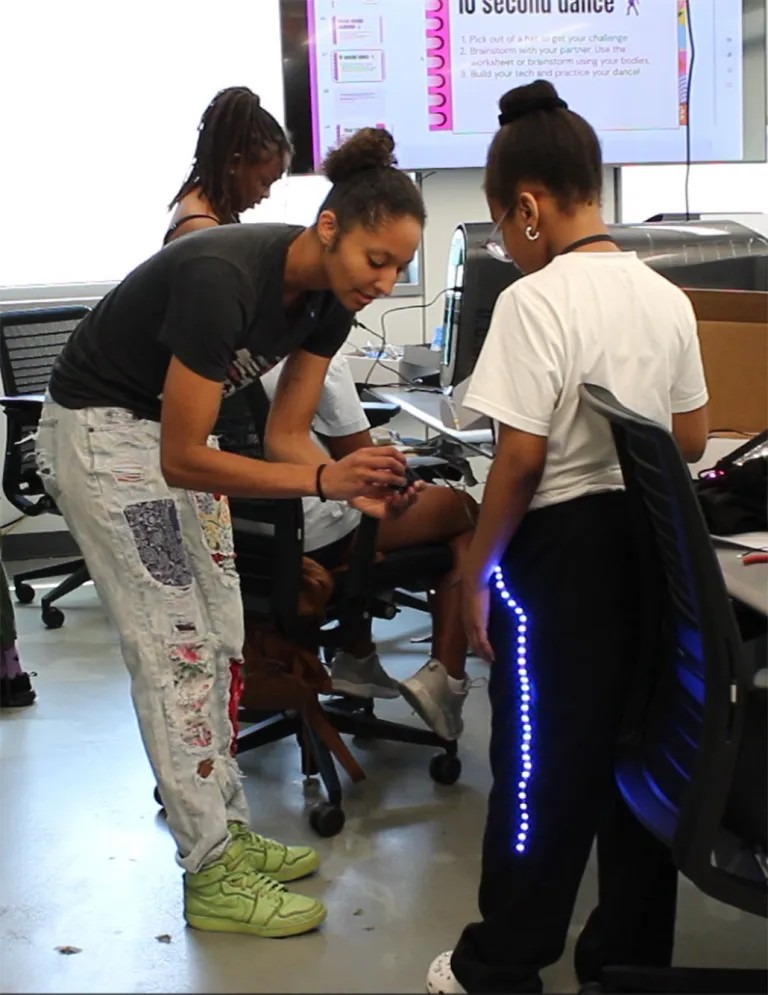
Step, shake, clap. A group of teens moves to the beat. In a video of their dance, colorful starbursts break out from their hands. These girls created their own moves. For the video, they also coded visual effects that respond to those motions.
Combining dance with coding opens up all sorts of creative possibilities.
“If you put your right fist in the air, you could trigger lightning to come down,” says engineer Kayla DesPortes in New York City. At New York University, she studies ways to teach computing. The teens created these flashy effects with a technology called danceON. Kids have been learning to use this tool at a yearly summer program called STEM From Dance.
The program’s goal: Make sure girls of color know that they can be part of STEM fields, founder Yamilée Toussaint explains in a video. “They can be the future engineers and scientists that our world needs.” (STEM stands for science, technology, engineering and math.)
Western science has not always been open to everyone. The stereotype that only certain types of people belong in science and engineering has been tough to shake off. But many researchers are working to change things.
Here, we meet some of the people who are reimagining how we do science. Their visions and dances, sounds and gatherings help bring science to everyone. At the same time, they’re expanding what science and engineering can be.
“Any kind of dancing, I’m there,” says DesPortes. In college, she joined a salsa rueda dance troupe. They would form a circle and dance in response to a leader who called out moves.
At first, dance was just her hobby. After college, she worked as an electrical and computer engineer. But at work, she didn’t meet many people who looked like her or shared her culture. “It’s not a very diverse field,” she says. She found that strange. After all, pretty much everyone uses computers in some way. “When you think of how computers are integrated into our lives,” she says, “there’s nothing narrow about it.”
So DesPortes decided she wanted to do more than just build technology. She wanted to explore new ways to use it. “How can it be used to communicate things? How can it make you feel things?”
When she got a chance to start working with STEM From Dance, she was thrilled. Girls in this program work together to create dances. At the same time, they use tech to express themselves. “The way these students describe their dances, it is a representation of themselves, their identities, their interests,” she says.
Unfortunately, DesPortes found that available tech-teaching tools were “really bad for anything having to do with body and movement.” So she set out to design one herself. It had to be easy for anyone to start using and push them to learn new things.
It also had to fit with the girls’ visions for their dances. “You can’t make them do a dumb dance,” DesPortes jokes.
During the COVID-19 pandemic, she became part of a team that developed danceON. At the time, “TikTok dances were popping off,” she recalls. So it made sense to give young people the ability to code special effects onto dance videos and share their work virtually.
Since then, DesPortes has been developing a new tool: DanceBits. Its wearable system of sensors connect to lights. Dancers can program the lights ahead of time. Or they can tap the sensors while dancing to turn lights on or off — even to change color.
This lets dancers improvise, DesPortes explains. They can “experiment and play with the technology and movement.”
DesPortes loves guiding students as they create incredible dances and learn about tech. But there’s more to this. “The students have agency and control over all the decisions [about the tech],” she says. When it comes to your phone, social-media accounts and chatbots, she notes, “big tech has control of it all. But that doesn’t need to be the case.”
Many times, DesPortes has seen a transformation. A young girl who had never seen herself in tech now realizes, “I’m a STEM person. I’m a computing person.”
Amy Bower works at Woods Hole Oceanographic Institution in Massachusetts. This ocean scientist has worked on ways to represent data as sound. It gives anyone who learns best through listening a new way to understand data.
Growing up on the Massachusetts coast, “I was naturally very interested in what the ocean was doing all the time,” she noted in a Tumble Science podcast. She looked for critters under rocks. She loved watching storms. She also asked herself many questions. For example: Why are the waves bigger today? What makes the tides work?
It was no surprise when she decided to study oceanography. While in graduate school, though, she began slowly losing her sight. Doctors told her there would be no cure. Over time, she went blind.